
Introduction: Forging the shield: Greece’s strategic renewal in the age of modern warfare
Greece occupies a distinct position within the European (Union) and NATO security landscape, influenced and shaped by enduring threat perceptions that predate Russia’s war of aggression against Ukraine. In contrast to many Allies whose strategic outlook and defence readiness have been fundamentally altered only in recent years, Greece has long faced a persistent and proximate security challenge stemming from one of its neighbours, namely Türkiye. The latter is also a NATO Ally, adding more complexity to the intense relationship between the two countries. This structural condition has been translated into sustained and comparatively high levels of defence expenditure over the last decade (Table 1), though it was partially affected during the peak years of the Greek sovereign debt and financial crisis.
Greek threat perceptions differ markedly from those of several Central, Northern and Western European states. Greece does not benefit from the geographic insulation or benign neighbourhood enjoyed by other countries. As has been publicly emphasised by the Minister of National Defence, the country is “not fortunate enough to be situated in a geographic location similar to Luxembourg’s”1. On the contrary, it operates in a volatile regional setting characterised by contested maritime and airspace claims, recurrent crises, the Turkish military invasion and occupation of 36% of the territory of the Republic of Cyprus and a high potential for escalation. This reality has traditionally necessitated a defence posture centred on readiness, deterrence and credible military capabilities, largely independent of broader Alliance-wide trend shifts (or inactivity).
Beyond traditional military threats, Greece has increasingly had to adapt its defence planning to new and non-conventional security challenges. Climate change has emerged as a threat multiplier, prompting the establishment in 2024 of a dedicated “Construction and Disaster Response” command, which is directly subordinate to the Hellenic National Defence General Staff (HNDGS).2 At the same time, hybrid threats (e.g., the weaponisation of migration flows), which may require a whole-of-government approach, have underscored the need for integrated civil-military responses.
Following the financial crisis, Greece has gradually refocused on rebuilding and modernising its defence capabilities. This process has placed particular emphasis on procuring new equipment and modernising existing equipment, alongside the revitalisation of the domestic defence industry, reflecting both operational requirements and broader considerations related to strategic autonomy and resilience. While defence expenditure absorbs a relatively significant share of the country’s Gross Domestic Product (GDP), Greece has sought to balance security imperatives with fiscal responsibility. Current defence planning operates within the constraints of a rational and sustainable fiscal policy, explicitly aimed at avoiding the structural imbalances and vulnerabilities that characterised earlier periods.
Table 1: Greece’s defence expenditure as a share of real GDP and defence expenditure per capita (2014-2025)
| Greece | 2014 | 2015 | 2016 | 2017 | 2018 | 2019 | 2020 | 2021 | 2022 | 2023 | 2024e | 2025e |
|---|---|---|---|---|---|---|---|---|---|---|---|---|
| Share of real GDP (%) | 2.24 | 2.32 | 2.40 | 2.37 | 2.52 | 2.42 | 2.87 | 3.66 | 3.87 | 2.76 | 2.74 | 2.85 |
| Defence expenditure per capita (US dollars) | 429 | 447 | 466 | 467 | 509 | 500 | 539 | 750 | 856 | 627 | 637 | 678 |
Scroll horizontally to view the full table.
Source: NATO3, ‘e’: estimates
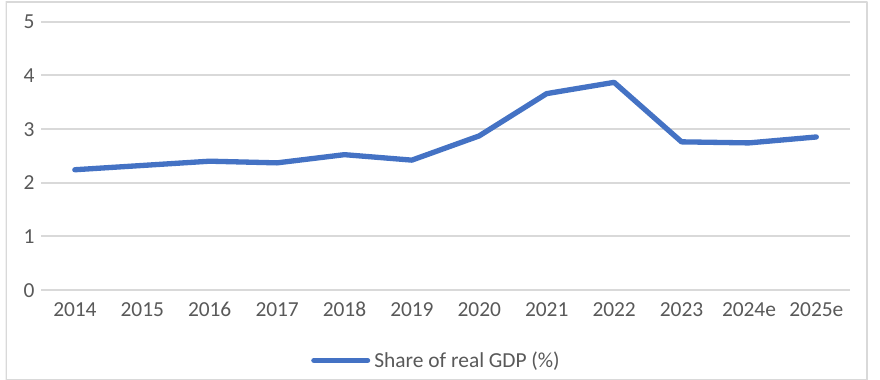
Source: NATO4, ‘e’: estimates
Defence budget: from strategy to implementation
As stated above, in the Greek case, NATO defence spending targets have been translated into national policy and budgetary frameworks in a manner that goes well beyond political signalling or agenda-setting. At present, the policy cycle has clearly advanced to the stage at which decisions have been taken and implementation is underway, supported by formal statements and multi-year financial commitments. The cornerstone of Greece’s defence planning framework is Agenda 2030, a comprehensive modernisation plan for the Armed Forces that provides strategic direction. It reflects an effort to systematise defence investments and modernise the structure and functioning of the Hellenic Armed Forces in line with national threat perceptions and international best practices, drawing on lessons learned from abroad. In particular, Agenda 20305 is structured around six interconnected axes: a) reorganisation of the Armed Forces, b) continuation, acceleration and optimisation of armament programmes, c) modernisation of the conscription and reserve model, d) enhanced care for permanent personnel, e) promotion of defence diplomacy, and f) strengthening, restructuring and upgrading the national defence industry.
A central implementation instrument of Agenda 2030 is the Long-term Planning of Defence Armaments of the Armed Forces 2025-2036, which translates strategic objectives into concrete capability development and procurement plans. The document was approved by the Government Council on National Security (KYSEA) (formerly known as the Government Council on Foreign and Defence Affairs) on 16 April 20256, providing high-level political endorsement for sustained defence expenditure. Although its full content is classified, the main elements of the long-term armaments planning include a total financial envelope of 25.8 billion EUR over 12 years, 68 distinct procurement and modernisation programmes across multiple domains, and up to 25% involvement of the national defence industry.7 Several flagship programmes are particularly indicative of Greece’s capability priorities:
The Achilles’ Shield: a 5-layered (i.e., missile, air, drone, naval and undersea) integrated defence initiative for the Eastern Aegean and Thrace, combining land-based, naval and air components, with a strong footprint of Israeli-origin systems,
Procurement of 20 F-35 5th-generation fighter aircraft, with an option for an additional 20,
Upgrade of 38 F-16 Block 50 aircraft to the F-16 Viper standard, complementing the ongoing upgrade of 83 F-16 Block 52+ aircraft,
Acquisition of 35 UH-60M Black Hawk transport helicopters,
Upgrade of frigates and modernisation of submarine platforms,
Investments in cyber warfare capabilities and unmanned aerial systems,
Replenishment and modernisation of ammunition stocks, and
The “Modern Fighter” programme (which will be discussed in subsequent sections).
Taken together, these measures demonstrate that national planning instruments are currently under implementation. Nevertheless, it remains to be seen whether Greece will achieve an annual allocation of 3.5% of GDP for core defence requirements by 2035, as agreed at the 2025 NATO Summit in The Hague. According to Kathimerini, members of the government’s economic team have acknowledged that, based on the current planning (including the long-term planning of defence armaments), Greece’s defence expenditure will remain at approximately 3% of GDP per year and that “we will see after 2030, depending on the course of our debt”. 8
Personnel: Building the force for the 21st Century
Personnel reform constitutes a central pillar of Agenda 2030, reflecting the recognition that capability modernisation cannot be sustained without a parallel restructuring and strengthening of human resources, especially at times of demographic threat. A key legislative component in this direction is the “Roadmap for the Transition of the Armed Forces to the New Era”, which was approved by the Hellenic Parliament on 9 January 2026 and introduces wide-ranging changes affecting officers, non-commissioned officers (NCOs), professional soldiers, and conscripts.9 The Roadmap seeks to recalibrate the internal personnel structure among other measures, by addressing imbalances in rank distribution and career progression. A central objective is to increase the number of operationally deployable personnel, particularly at the lower and middle ranks, while containing overrepresentation at senior levels and addressing rank inflation across the force, whereby a large proportion of NCOs ultimately retire as officers (e.g., as Lieutenant Colonels).10 This decision attempts to tackle long-standing issues that have led to significant anomalies within the Hellenic Armed Forces and to remedy the relevant vulnerabilities. In May 2025, the Minister of National Defence stressed the need for more soldiers “rather than more major generals and generals without soldiers”11. Furthermore, the Roadmap foresees the introduction of a voluntary 12-month military service for women, aiming to expand the recruitment pool, align Greece with broader trends12 and modernise the social profile of the Hellenic Armed Forces. The first female (volunteer) conscripts began their military service in June 2026. 13
Nonetheless, the roadmap has generated some domestic opposition, particularly among NCOs, Greek citizens residing abroad and Greek students in the homeland. NCOs have expressed concerns that the new promotion rules limit their professional opportunities for advancement to officer ranks compared with the existing system.14
Meanwhile, one of the most pressing challenges facing the Hellenic Armed Forces, and particularly the Hellenic Navy, is personnel attrition driven by labour market dynamics. As acknowledged by the Minister of National Defence, during periods of high unemployment, personnel retention was less problematic, whereas under current economic conditions, the “temptation” to leave the military has increased substantially. The issue also concerns enrolment at military academies, as approximately 450 places remained unfilled in 2024.15
To address this phenomenon, a package of retention incentives is to be introduced. These include salary increases for permanent personnel to improve the military's overall attractiveness.16 Moreover, housing has emerged as a critical factor in personnel retention, especially on the borders. As part of Agenda 2030, the Ministry plans to construct approximately 2,000 housing units by 2027, primarily on the islands of the Eastern Aegean and in Thrace, aiming to alleviate financial pressure on military families and improve their living conditions. The reserve component has also attracted attention, with Greece setting an objective of reaching 150,000 active reservists by 203017, reflecting lessons learned from recent armed conflicts and best practices implemented by Israel and Finland. At the core of this effort lies a deliberate shift away from a reserve that is, in some respects, largely symbolic (traditionally marked by minimal training, limited readiness and outdated equipment) towards a credible, well-trained and sufficiently equipped force capable of contributing meaningfully to deterrence. The Gov.gr portal, Greece’s single digital public-administration portal, will facilitate communication between military authorities and reservists.
Financing the abovementioned measures relies on a combination of defence budget allocations and internal cost-saving reforms that are currently underway. For instance, the planned second and third phases of consolidating more than 200 military camps and courts aim to reduce overheads and reallocate resources toward the priorities outlined in Agenda 2030. In addition, organisational streamlining, such as the abolition of the 1st Army Corps, will free approximately 30,000 person-hours per month and reduce administrative burdens without undermining operational capacity, according to the Ministry.18
Modernising Greece’s land capabilities
Over the next five years and beyond, Greece is pursuing a series of targeted capability investments in the land domain. These choices are embedded within the broader framework of the Agenda 2030 and the Long-term Planning of Defence Armaments of the Armed Forces 2025-2036 (see above). A flagship decision in this domain concerns long-range precision fires. On 16 December 2025, the Israeli defence company “Elbit Systems” announced that it had received formal notification that Greece’s KYSEA, as well as the Hellenic Parliament, had approved funding for the procurement of the PULS (Precise & Universal Launching System) multiple rocket artillery system for the Hellenic Army.19
Beyond the PULS programme, a number of additional land-domain initiatives have been reported in open sources and defence media.20 Land-domain investments are closely linked to the broader “Achilles’ Shield” concept, which consists, inter alia, of Israeli-origin land-based air defence systems, such as SPYDER, Barak MX and David’s Sling. Greece also participates in the EU’s Federated Integrated Air and Missile Defence, one of four European Defence Projects of Common Interest (EDPCI) involving Greece. Other investments could include modernising the armoured fleet, potentially taking into account partnerships between the Greek defence industry and leading European defence manufacturers. In particular, in April 2025, METLEN and KNDS France signed an exclusive partnership agreement for 8x8 armoured vehicles (VBCI PHILOCTETES) “designed to meet the Hellenic Army’s operational requirement for a large number of 8x8 infantry fighting vehicles as well as that of other European armies”21. In December 2025, Metlen Energy & Metals, through its M Technologies Sector, announced the signing of a contract with KNDS Deutschland to deliver 200 assemblies for the LEOPARD 2A8, which will be manufactured in Volos, Greece.22
Greece initially requested approximately 3 billion EUR under the EU’s Security Action for Europe (SAFE) Regulation to finance 30 armament programmes, including the procurement of general-purpose vehicles (also suitable for civil protection use), anti-tank missiles, and the equipment kit for the “Modern Fighter 2030”.23 Recent information from Kathimerini indicates that, before the end of 2025, Greece prioritised six programmes to come closer to the Commission’s budget allocation of 787 million EUR: a) development of a communication satellite, b) acquisition of microsatellites with synthetic imaging capabilities, c) further development of anti-drone systems, d) acquisition of crypto devices, e) acquisition of wireless communication systems, and f) development of unmanned systems.24
Against this background, the “Modern Fighter 2030” programme constitutes a distinct and emblematic element of Greece’s land warfare modernisation. The initiative aims to equip each individual soldier with new-generation personal equipment by 2030, effectively creating the “21st Century Greek Soldier”.25 This equipment includes, among others, a modernised G3 rifle and a new sniper rifle, Command and Control (C2) systems and sensor-enabled uniforms. According to official statements, the Greek defence industry is capable of producing approximately 90% of the required equipment, underscoring the programme’s strong domestic industrial dimension.
Several interrelated factors drive Greece’s land-warfare and broader defence investment choices, revealing key aspects of its strategic priorities and threat perceptions. First of all, these decisions are shaped by the pursuit of increasing deterrence capabilities vis-à-vis Türkiye. Given Greece’s enduring threat perception, emphasis is placed on deterrence through military superiority. Next, there is a clear effort to support and revitalise the domestic defence industry by prioritising domestic production. Last but not least, they may be used as a tool to deepen industrial and political ties with key international partners, notably the United States (e.g., US-origin platforms dominate rotary-wing capabilities) and Israel (e.g., strong artillery and air defence capabilities). In this context, political uncertainty surrounding US foreign policy may incentivise Athens to pursue additional US defence procurements, serving both capability needs and the objective of signalling Greece’s strategic value and reliability as a partner aligned with American interests.
The rise of the unmanned: Greece enters the “Drone Age”
In recent years, and particularly following the lessons learned from Russia’s war of aggression against Ukraine, Greece has accelerated its entry into what has been publicly described as the “drone age”26, aiming to adopt unmanned systems across multiple domains. This shift is driven by the recognition that drones are no longer niche enablers, but core components of modern warfare, relevant to conventional operations, hybrid threats and crisis response linked to climate-related disasters.
The emphasis is on scalability, rapid production, and adaptability rather than on reliance on a limited number of high-cost platforms. A key innovation in this regard is the establishment of military-operated drone production facilities. At the 306 Telecommunications Base Factory, Greece has developed the capacity to produce Category I drones, alongside two prototype portable drone production stations designed to accompany major units on the ground and enable on-site First Person View (FPV) drone manufacturing.27 The factory has the potential to produce more than 1,000 drones annually, while it is noteworthy that the drones’ software is also developed in-house. A second production unit is being established on the premises of the 316 Technical Area Workshop with an expected capacity of up to 1,000 FPV drones per month.28
Greece hosts a rapidly expanding domestic drone ecosystem, combining military factories and research centres, private companies, research institutions and universities. An indicative list of actors in the (anti-)drone industry includes IKH, SAS Technologies, Altus, Epsilon Aero Vision, NYX Productions, UCANDRONE, Velos Rotors and Delian Alliance Industries. These companies are reinforced by academic institutions, notably the National Technical University of Athens, Aristotle University of Thessaloniki (AUTH) and the University of Patras, which contribute to research and testing. Human capital development is supported by new specialised Master’s programmes dedicated exclusively to drones, such as those offered by AUTH29 and the University of Western Attica (UNIWA)30.
The Ministry of National Defence, primarily through the Hellenic Centre for Defence Innovation (ELKAK), formalises the country’s intention to broaden its unmanned aerial and surface systems portfolio by evaluating and selecting proposals for funding for UAVs31, Unmanned Combat Aerial Vehicles (UCAVs)32 and Unmanned Surface Vessels (USVs)33. The 6th Branch (“Transformation, Innovation and Defence Technology”) of the HNDGS closely collaborates with ELKAK.34 In particular, the former collects technical requirements for new equipment from each General Staff and forwards them to the latter, which then identifies suitable legal entities to carry out the task. Meanwhile, operational testing and industry-military interaction are facilitated through large-scale exercises, such as “Aisios Oionos 2025” in Thrace, which involved companies producing (anti-)drone capabilities. At the international level, collaboration has expanded through the agreement signed in November 2025 between Greece and Ukraine to co-produce naval drones (USVs) in Greek shipyards35, with Greek industry expected to contribute to electronics, sensors and potentially munitions36. Last but not least, it has been announced that Greece will participate in the drone-relevant EDPCI, namely the DronE and Counter Drone European Resolve (DECODER).
As demonstrated by the aforementioned developments, drones are increasingly integrated into the Greek military doctrine, although the process remains ongoing. Training in drone operation is expanding and exercises increasingly incorporate Unmanned Aerial Vehicles (UAVs). The growing importance of anti-drone capabilities is also notable. Given Türkiye’s extensive and combat-proven drone industry, exemplified by Baykar systems, counter-UAV measures have become a strategic priority for both the development of the “Achilles’ Shield” and the integration of anti-drone systems (e.g., Centaur37) on Greek frigates during EUNAVFOR Operation Aspides in the Red Sea.
Notes & sources
Hellenic Republic Ministry of National Defence. 2024. https://www.mod.mil.gr/en/the-minister-of-national-defence-nikos-dendias-inaugurates-the-pavilion/.↩
Γενικό Επιτελείο Στρατού. 2024. Πρώτη Συνεδρίαση του νέου Ανώτατου Στρατιωτικού Συμβουλίου (ΑΣΣ). https://stelexi.army.gr/ekdiloseis/proti-synedriasi-tou-neou-anotatou-stratiotikou-symvouliou-ass-2/.↩
NATO. 2025. Defence Expenditure of NATO Countries (2014-2025). https://www.nato.int/content/dam/nato/webready/documents/finance/def-exp-2025-en.pdf.↩
Ibid.↩
Hellenic Republic Ministry of National Defence. 2024. The Minister of National Defence, Nikos Dendias, inaugurates the Pavilion of the Ministry of National Defence at the 88th Thessaloniki International Fair. https://www.mod.mil.gr/en/the-minister-of-national-defence-nikos-dendias-inaugurates-the-pavilion/.↩
The Prime Minister of the Hellenic Republic. 2025. Συνεδρίαση του Κυβερνητικού Συμβουλίου Εθνικής Ασφάλειας (ΚΥΣΕΑ). https://www.primeminister.gr/2025/04/16/36085.↩
Greek Minister of National Defence. 2025. Facebook post. https://www.facebook.com/dendiasnikos/posts/1230810505071283/.↩
Χρυσολωρά, Ε. 2025. Κατά 1 δισ. πρέπει να αυξήσει η Ελλάδα τις αμυντικές δαπάνες. https://www.kathimerini.gr/economy/563687413/kata-1-dis-prepei-na-ayxisei-i-ellada-tis-amyntikes-dapanes/.↩
Greek Ministry of National Defence. 2026. ΣΧΕΔΙΟ ΝΟΜΟΥ ΤΟΥ ΥΠΟΥΡΓΕΙΟΥ ΕΘΝΙΚΗΣ ΑΜΥΝΑΣ. https://www.mod.mil.gr/wp-content/uploads/2025/12/20251512095217modtpent_%CE%A3%CE%A7%CE%95%CE%94%CE%99%CE%9F-%CE%9D%CE%9F%CE%9C%CE%9F%CE%A5-1-min.pdf.↩
According to media reports, sources from the Ministry of National Defence have used a comparative example to describe the ‘hydrocephalic’ phenomenon that exists in the Hellenic Armed Forces. In particular, in the US, there are 113 Brigadier Generals compared to approximately 150 Brigadier Generals in the Hellenic Army. In the category of Major Generals and their equivalents in the Navy and the Air Force, the ratio is one per 7,936 members of the Armed Forces in the US, while in Greece it is one per 1,329. See Νέδος, B. 2025. Ενοπλες Δυνάμεις: Διαθέτουμε περισσότερους ταξιάρχους από τις ΗΠΑ. https://www.kathimerini.gr/visual/infographics/563417176/enoples-dynameis-diathetoyme-perissoteroys-taxiarchoys-apo-tis-ipa/.↩
Hellenic Republic Ministry of National Defence. 2025. Ομιλία Υπουργού Εθνικής Άμυνας Ν. Δένδια στην Ολομέλεια της Βουλής επί του Σχεδίου Νόμου «Ρύθμιση υγειονομικών θεμάτων των Ενόπλων Δυνάμεων και λοιπές διατάξεις». https://www.mod.mil.gr/omilia-ypoyrgoy-ethnikis-amynas-n-dendia-stin-olomeleia-tis-voylis/.↩
European Parliament. 2025. Conscription as an element in European Union preparedness.https://www.europarl.europa.eu/RegData/etudes/BRIE/2025/769541/EPRS_BRI(2025)769541_EN.pdf.↩
tovima.gr. 2025. Δένδιας: Το 2026 ξεκινά η εθελοντική στράτευση γυναικών – Τι είπε για τα κινητά εργοστάσια drones. https://www.tovima.gr/2025/10/30/politics/dendias-to-2026-ksekina-i-ethelontiki-strateysi-gynaikon-ti-eipe-gia-ta-kinita-ergostasia-drones/.↩
Hellenic Republic Ministry of National Defence. 2025. ΔΗΜΙΟΥΡΓΙΑ ΣΩΜΑΤΟΣ ΕΛΛΗΝΩΝ ΥΠΑΞΙΩΜΑΤΙΚΩΝ. https://www.eaas.gr/deltia-typoy/dimioyrgia-somatos-ellinon-ypaxiomatikon-0.↩
Hellenic Republic Ministry of National Defence. 2025. Παρέμβαση ΥΕΘΑ Ν. Δένδια στη Διαρκή Επιτροπή Εθνικής Άμυνας & Εξωτερικών Υποθέσεων. https://www.mod.mil.gr/paremvasi-yetha-n-dendia-sti-diarki-epitropi-ethnikis-amynas-amp/; Νέδου, B. 2024. Κίνητρα για περισσότερους νέους στις στρατιωτικές σχολές. https://www.kathimerini.gr/society/563205715/kinitra-gia-perissoteroys-neoys-stis-stratiotikes-scholes/.↩
For example, a 2nd Lieutenant in the Hellenic Army (with 3 years of service, single status and posted to a border area) will receive a net monthly salary increase of approximately 380 EUR, rising from 1,197 EUR to 1,576 EUR. In addition, the Roadmap introduces a monthly increase of the responsibility allowance (increases range from 156% and 189% for Majors and Lieutenant Colonels respectively to 5% for the Chief of the HNDGS). Compensation increases are also foreseen for conscripts (from 8.8 EUR per month to 100 EUR per month for those serving in Evros and islands of the Eastern Aegean and 50 EUR per month for those serving in the mainland). See Hellenic Republic Ministry of National Defence. n.d. mod.mil.gr.↩
Hellenic Republic Ministry of National Defence. 2025. Minister of National Defence Nikos Dendias Attends Conference Regarding “The Reform of the Institution of Reserves”, at Hellenic Military Academy. https://www.mod.mil.gr/en/minister-of-national-defence-nikos-dendias-attends-conference-regarding-the/.↩
Hellenic Republic Ministry of National Defence. 2025. https://www.mod.mil.gr/paroysiastike-ton-yetha-n-dendia-v-fasi-tis-metarrythmisis-atzenta/.↩
Elbit Systems. 2025. Elbit Systems' PULS Rocket Artillery System Selected by the Hellenic Armed Forces. https://www.elbitsystems.com/news/elbit-systems-puls-rocket-artillery-system-selected-hellenic-armed-forces.↩
Defea. 2025. 12 Years Armament Planning of the Hellenic Armed Forces. https://defea.gr/12-years-armament-planning-of-the-hellenic-armed-forces-v1/.↩
Melten. 2025. KNDS France and METLEN Partner for the Production of the VBCI PHILOCTETES® in Greece. https://www.metlen.com/news/press-releases/knds-france-and-metlen-partner-for-the-production-of-the-vbci-philoctetes-in-greece/.↩
Melten. 2025. METLEN and KNDS strengthen their strategic partnership with a new agreement for LEOPARD 2A8 battle tanks. https://www.metlengroup.com/news/press-releases/metlen-and-knds-strengthen-their-strategic-partnership-with-a-new-agreement-for-leopard-2a8-battle-tanks/.↩
Nedos, V. 2025. Athens finalizing SAFE procurement list. https://www.ekathimerini.com/politics/foreign-policy/1287356/athens-finalizing-safe-procurement-list/.↩
Ioannidis, S. 2026. Greece narrows SAFE loan bid to six defense programs. https://www.ekathimerini.com/politics/foreign-policy/1291923/greece-narrows-safe-loan-bid-to-six-defense-programs/.↩
Hellenic Republic Ministry of National Defence. 2025. Minister of National Defence Nikos Dendias Attends “Modern Fighter” Upgrade Programme. https://www.mod.mil.gr/en/minister-of-national-defence-nikos-dendias-attends-quot-modern-fighter/.↩
Boyle, M. J. 2020. The Drone Age: How Drone Technology Will Change War and Peace. https://doi.org/10.1093/oso/9780190635862.001.0001.↩
Hellenic Republic Ministry of National Defence. 2025. The Minister of National Defence Nikos Dendias Visits the Drones Production Factory (306 Telecommunications Base Factory) in Acharnes. https://www.mod.mil.gr/en/the-minister-of-national-defence-nikos-dendias-visits-the-drones/.↩
Hellenic Republic Ministry of National Defence. 2025. The Minister of National Defence Nikos Dendias visits the 316 Technical Area Workshop and the Supreme Military Command of Thrace Area of Responsibility, in Xanthi. https://www.mod.mil.gr/en/the-minister-of-national-defence-nikos-dendias-visits-the-316/.↩
University of Thessaloniki. n.d. Aerial Autonomous Systems. https://uav.ece.auth.gr/en/home-eng/.↩
University of West Attica. n.d. Unmanned Autonomous and Remote Controlled Systems. http://msc-drones.uniwa.gr/.↩
The Hellenic Center for Defence Innovation. 2025. ΕΛΛΗΝΙΚΟ ΚΕΝΤΡΟ ΑΜΥΝΤΙΚΗΣ ΚΑΙΝΟΤΟΜΙΑΣ ΑΕ. https://www.elkak.gr/sites/default/upload/solicitations/2025-03/04_25_0.pdf.↩
The Hellenic Center for Defence Innovation. 2025. https://www.elkak.gr/sites/default/upload/solicitations/2025-09/20250920_RFI%20___%20UCAV%20CLASS%20I_final.pdf.↩
The Hellenic Center for Defence Innovation. 2025. Ανάπτυξη Μη Επανδρωμένων Θαλασσίων Σκαφών Επιφανείας (USV). https://www.elkak.gr/en/usv.↩
Ιωαννίδης, Σ. 2024. Νέος Κλάδος στο ΓΕΕΘΑ – Στα πρότυπα του Ισραήλ οι Ενοπλες Δυνάμεις. https://www.kathimerini.gr/politics/562897288/neos-klados-sto-geetha-sta-protypa-toy-israil-oi-enoples-dynameis/.↩
Michalopoulos, S. 2025. Greece and Ukraine decide to co-produce sea drones. https://www.euractiv.com/news/greece-and-ukraine-decide-to-co-produce-sea-drones/.↩
Khomenko, V. 2025. Ukraine and Greece to Jointly Manufacture Naval Drones. https://militarnyi.com/en/news/ukraine-and-greece-to-jointly-manufacture-naval-drones/.↩
The Hellenic Aerospace Industry (EAV) is a major state-owned company which develops the Centaur anti-drone system. However, it operates under close central government supervision, which imposes several constraints and limitations, including the inability to offer competitive salaries.↩
Keep a copy of the report
Greece · Spyros Blavoukos & Panos Politis Lamprou · EDINA V